Press Conference: New Promotional Materials for 2025 and 2026
St. Catherine’s Day Customs and Traditions
Saint Catherine of Alexandria was one of the most popular virgin martyrs of early Christianity. Her feast day is celebrated on 25th November. Little is known about her life, and only a few legends about her have survived.
According to these legends, besides her extraordinary beauty, she was also highly educated and stood out among her contemporaries from an early age. Born into a noble family in Alexandria, she was known for repeatedly rejecting her suitors. After a hermit told her that Christ was her true bridegroom, Catherine converted to Christianity. Moreover, during a debate, she managed to convert fifty pagan scholars to Christianity, whom Emperor Maximinus had summoned. The emperor then offered her the imperial throne. When Catherine refused, he resorted to violence: he had her whipped and imprisoned, and later ordered her to be tortured on a spiked wheel. However, the wheel miraculously shattered into pieces in response to Catherine’s prayers. Eventually, the emperor ordered the martyr to be beheaded. According to the legend, when her head fell, angels carried her body to Mount Sinai, where she was buried. Today, Saint Catherine’s Monastery stands above her tomb.
Numerous beliefs, folk customs and predictions are associated with St. Catherine’s Day:
- “If Catherine´s Day is frosty, Christmas will be slushy.” – This is what the traditional weather saying predicts. It means that if there is frost on 25th November, rainy and slushy weather can be expected at Christmas.
- The Catherine’s Branch – If a girl placed a freshly cut tree branch in water on St. Catherine’s Day and it blossomed by Christmas, it was believed that she would get married the following year.
- Predicting Future Wives – Young unmarried men would secretly place a piece of women’s clothing under their pillows in the hope of seeing their future wives in their dreams.
- Prohibition of Certain Activities – St. Catherine’s Day was traditionally considered a day when certain household and agricultural activities were forbidden. Women were not allowed to bake bread or spin yarn, and animals were not to be harnessed, as these activities were believed to bring bad luck.
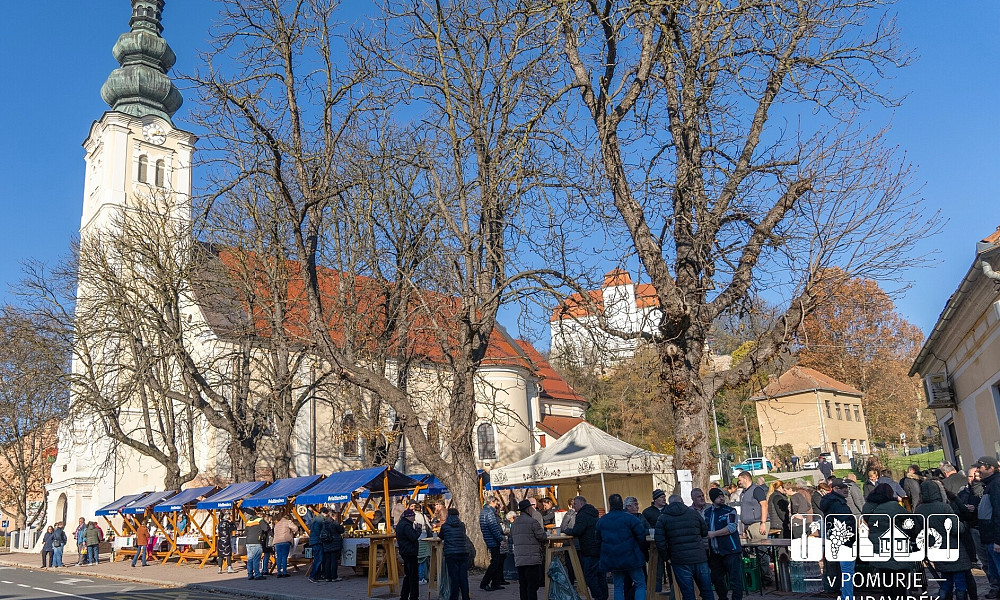
In the past, 25th November, St. Catherine’s Day, was also regarded as one of the important celebrations in the Lendava region, as it marks the feast day of Saint Catherine of Alexandria, the patron saint of Lendava’s parish church. Today, a traditional craft and market fair is held every year in the church square on this occasion. Visitors can browse and purchase a variety of handmade items, including objects made of wood, ceramics, corn husks and wicker.